
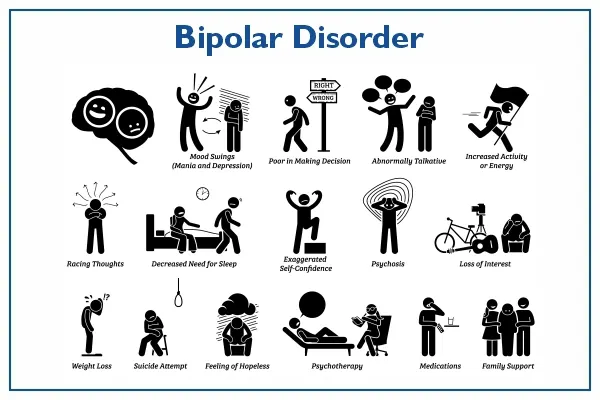
Overview
Bipolar Disorder also called as the “manic-depressive infection”
is a mental disease that reasons unusual shifts in mood, temper,
strength, activity tiers, concentration and the potential to carry
out daily tasks.
There are three forms of bipolar disorders starting from the
periods of ‘extremely up’ i.e. elated, irritable or energized
behavior called “manic episodes” to ‘extremely down’ i.e. unhappy,
indifferent or hopeless periods referred to as “depressive
episodes”. Less excessive or intermediate manic intervals are
referred as “hypomanic episodes”.
Bipolar Disorder-I described as manic episodes prevail at least
for 7 days which might go extreme that the patient need on-spot
health emergency care. Usually, depressive episodes occur as well,
commonly lasting at the least 2 weeks. Episodes of despair with
mixed functions (having depressive signs and manic signs on the
identical time) also are possible.
Bipolar Disorder-II defined as a pattern of depressive episodes
and hypomanic episodes, is not the full-blown manic episodes &
seems low against Bipolar Disorder-I.
Cyclothymic Disorder defined through the durations of hypomanic as
well as periods of depressive symptoms last for at least 2 years
(in kids and adolescents). However, the symptoms do not meet the
diagnostic necessities for a hypomanic episode and a depressive
episode.
Sometimes someone may carry signs of bipolar disorder that do not
fit the three categories indexed above, which is known as
“different and unspecified bipolar disorder and associated
problems.”
Bipolar sickness is usually recognized during childhood (teen
years) or early maturity. Occasionally, bipolar symptoms are seen
in kids. Bipolar ailment can also be found in a pregnant woman or
following the childbirth. Although the signs and symptoms may vary
through the years, bipolar ailment usually requires lifelong
treatment. Following a proper prescribed treatment plan Healthcare
providers can help humans to manage and improve their well beings.
Signs & Symptoms
People with bipolar sickness suffer periods of unusually extreme
emotions, changes in sleep style, hobbies and uncharacteristic
behaviors without spotting their harmful or undesirable
consequences. These intervals are called “mood episodes.” Mood
episodes are very exclusive from the moods and behaviors which can
be said normal for a person. During an episode, the signs remain
the whole day for maximum. Episodes may prolong for longer
durations, days or weeks.
People having manic episode Vs depressive episode:
A brief comparison:
Feel very Up, happy elated, irritable or touchy Vs
Feel very Down, unhappy, empty, involved or hopeless
Feel “jumpy” or “wired” Vs
Feel slowed down or restless
Have a decreased want for sleep Vs
Have too much sleep, awaken too early
Have a lack of appetite Vs
Excessive urge for food
Talk very fast about a number of various things Vs
Talk slowly, feel like they’ve nothing to say, forget loads
Feel like their thoughts are racing Vs
Problem in concentrating or making selections
Think they could do a lot of things right away Vs
Feel unable to do even simple matters
Do risky things that show bad judgment, consisting of consume and
drink excessively, spend or give away quite a few cash, or have
reckless sex Vs
Have little interest in almost all activities, a decreased or
absent sex force, or an incapability to enjoy pride
Feel they’re unusually important, gifted or effective Vs
Feel hopeless or worthless, thinking of suicide
Sometimes humans revel in both manic and depressive signs inside
the identical episode. This sort of episode is referred to as an
episode with mixed features. People experiencing an episode with
mixed features may also experience very sad, empty, or hopeless,
even as at the same time feeling extremely energized.
A person may have bipolar sickness even though their signs and
symptoms are less severe. For instance, some human beings with
bipolar sickness experience hypomania, a less severe shape of
mania. During a hypomanic episode, someone may also feel very
good, be capable of get things achieved, and preserve up with
day-to-day activities. The patient won’t experience anything
incorrect, but own family and buddies may realize the change in
mood or activity as viable bipolar sickness. Without right
treatment, conditions with hypomania can be worsened to hyper
mania episode depression.
Diagnosis
Proper prognosis and remedy can assist people with bipolar
sickness to lead a healthy and active life. Talking with a doctor
or a licensed healthcare provider is the first step. The
healthcare provider can complete a physical exam and order
necessary clinical assessments to rule out different conditions.
The healthcare issuer might also then undertake an intellectual
fitness evaluation test or offer a referral to a trained mental
fitness care provider, such as a psychiatrist, psychologist, or
medical social worker who has specialization in diagnosing and
treating bipolar sickness.
Some bipolar disorder signs are just like the ones of different
ailments, which can make it tough for a health caretaker to make a
diagnosis. In addition, many people may have bipolar sickness
together with other mental ailments like tension, substance-use or
a consuming ailment. People with bipolar sickness have an
increased threat of getting thyroid disorder, migraine
complications, heart disorder, diabetes, weight problems and
different physical ailments.
Psychosis: Sometimes, someone with excessive episodes of mania or
despair may additionally revel in psychotic signs and symptoms
with hallucinations or delusions. The psychotic signs have a
tendency to match the individual’s severe temper.
For example:
- People having psychotic manic symptoms throughout a manic episode may have the unrealistic notion that they’re well-known, rich or have special powers.
- People having psychotic symptoms at some point of a depressive episode may falsely believe they are financially ruined and penniless, have devoted a crime or have an extreme contamination.
As a result, people with bipolar disease who have psychotic symptoms are sometime incorrectly recognized with schizophrenia. When people have symptoms of bipolar disorder and suffer periods of psychosis which might be separate from mood episodes, the perfect diagnosis may be schizoaffective ailment.
Risk Factors
Researchers are analyzing the possible reasons of bipolar ailment.
Most agree that there may be no single motive and it’s far
possibly that many elements make a contribution to a person’s
hazard of having the infection.
Brain Structure & Functioning: Some studies suggest that the
brains of people with bipolar disease might also differ from the
brains of folks who do no longer have bipolar disease or another
mental disease. Learning more may assist Scientists to understand
bipolar sickness and decide which remedies will work first-rate.
At this time, fitness care carriers base the prognosis and
treatment plan on someone’s symptoms and history, in preference to
mind imaging or different diagnostic tests.
Genetics: Some researches indicate that human beings with positive
genes are more likely to develop bipolar ailment. Research
additionally shows that humans who’ve a figure or sibling with
bipolar disease have a greater risk of getting the ailment
themselves.
When to look a Doctor?
Bipolar Disorder Disease is a mental sickness that need an
immediate medical attention.
We, at Islamabad Rehab Center in Islamabad,
are specialized to treat this deadly Disease with the help of our
Team of Experts & Professionals.
For more details, please visit our website
https://thenewlife.com.pk/