
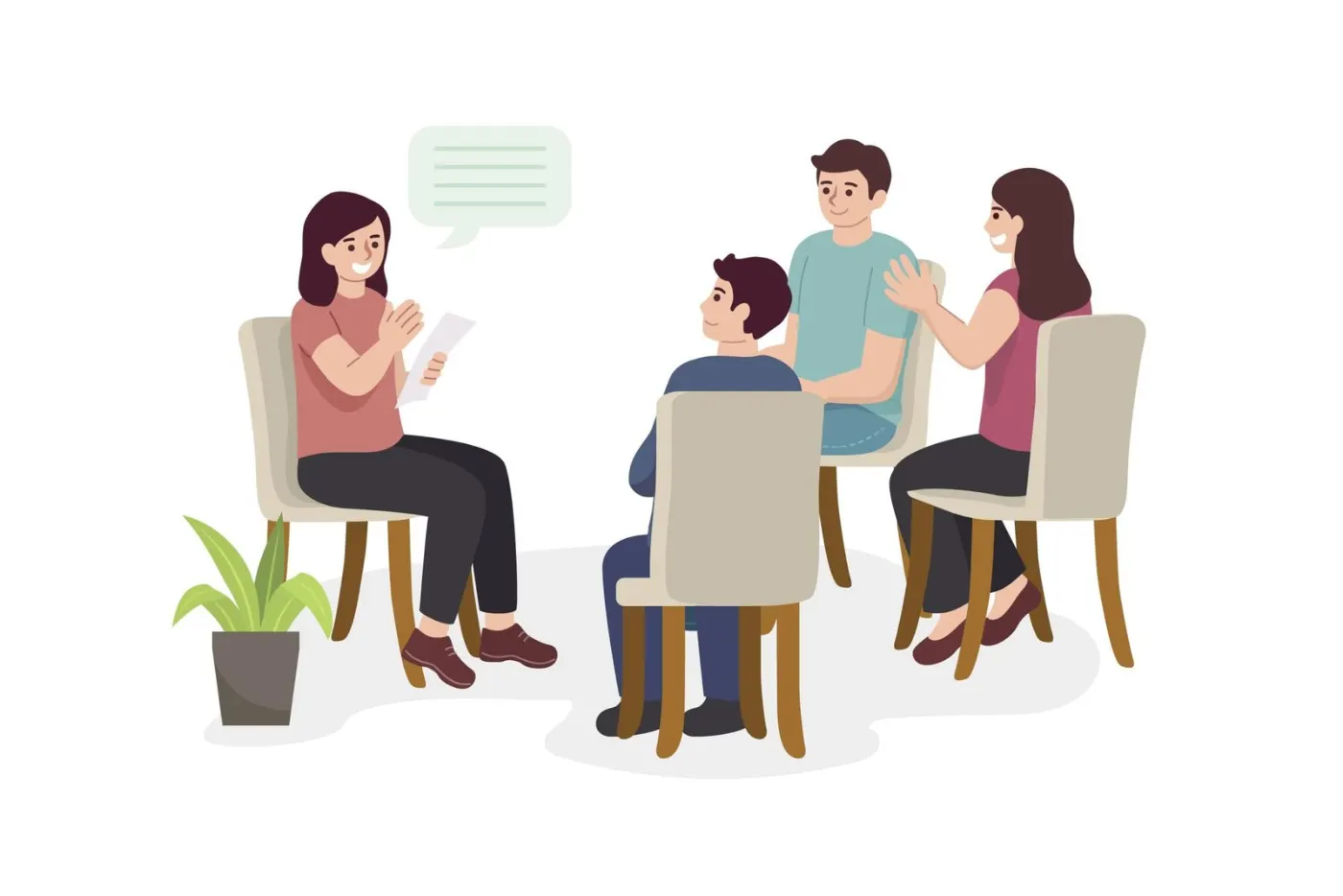
Interpersonal Communication is a channel by which the Humans use
to convey their feelings thru verbal, non-verbal &
face-to-face messages. The conversation is not just about what is
actually said or the language used but is important how the
non-verbal messages sent at what tone of voice, gestures and
facial expressions.
When two or more people are in a place and are aware of other’s
presence, the conversation takes place regardless of how diffused
or accidental is it. Without speech, one can guess the cues, clues
or facial expression and form an impact of other’s position,
emotional state, personality and intentions. Although no verbal
exchange happen, people acquire messages thru non-verbal conduct.
Research has been done to interrupt down interpersonal verbal
exchange into number of elements in order to get the problems
understood in real sense. Those elements are consisting of the
following indicators.
The Communicators
For any conversation to occur there must be at the least two
humans involved, a sender and a receiver of the message. It
presents a one-way communication process where
one character sends the message and the opposite gets it. One
person is speaking and the other is listening in Interpersonal
Communication.
Two-way communication is a bit complicated, with humans sending
and receiving messages to and from every different communicator.
In other words, this communication is an interactive technique
where One character is speaking, the opposite is listening and
while listening they are sending comments in the form of smiles,
head nods and so on.
Message is no longer the handiest manner of speech used or
conveyed, non-verbal messages exchanged thru facial expressions,
tone of voice, gestures and body language. Non-verbal behavior can
carry the facts to screen the emotional attitudes which underlie
the content of speech.
Noise has a special effect and role in the conversation theory. It
refers to whatever that distorts the message, what is obtained is
not the same as what is supposed by the speaker. Different factors
are considered to be a ‘noise’. Physical ‘noise’ as an instance, a
low-flying jet aircraft noise can interfere and ruin our verbal
exchange of conversation. The use of complex jargon, inappropriate
frame of language, inattention, disinterest and cultural
differences may be considered ‘noise’ in the context of
interpersonal communication. In other words, any distortion or
inconsistencies that occur at some point of talk can be seen as
Noise.
Feedback means those messages which the receiver returns, and let
the sender to know how appropriately the message has been
received, as well as the receiver’s reaction. The receiver may
also respond to the unintentional message to the intentional
message. Types of remarks range from direct verbal statements, as
an example “Say that once more, I do not apprehend”, to diffused
facial expressions or adjustments in posture that might indicate
to the sender that the receiver feels uncomfortable with the
message. Feedback lets the sender to alter, adapt or repeat the
message with the intention to enhance the understanding of
conversation.
Context
All verbal exchange is prompted by the context wherein it takes
place. However, apart from searching at the situational context,
in a room, workplace, or perhaps outside, the social context needs
to be taken into consideration. The emotional climate and
participants’ expectancy of the interaction can even affect the
communication.
We may also at times attempt not to talk however speaking is not
always a choice. In fact the tougher we try not to communicate,
the more we do. By now, not communicating we are speaking
something possibly that we are shy, possibly that we are irritated
or sulking, perhaps that we are too busy. Ignoring any person is
speaking, we may not tell them we are ignoring however through
non-verbal exchange we hope to make that obvious.
We speak a long way more with non-verbal conversation than we do
with phrases. Our frame, eye-touch, the smallest and maximum
subtle of mannerisms are all methods of communicating with others.
Furthermore, we are constantly being communicated to, we pick up
alerts from others and interpret them in certain approaches and
whether or not or no longer we recognize is based on how skilled
we are at deciphering interpersonal conversation.
Once it’s Out, it’s Out.
The system of Interpersonal Communication is irreversible, you can
wish you had not said something and you can apologize for
something you stated and later regret – however you can’t take it
back.
We frequently behave and consequently speak to others primarily
based on preceding communication encounters. These encounters may
or won’t be suitable factors of reference. We stereotype people,
often subconsciously, may be by gender, social standing, faith,
race, age and other elements – stereotypes are generalizations,
often exaggerated.
Because of these stereotypes, whilst we communicate with people we
can carry with us certain preconceptions of what they may be
thinking or how they may be possibly to act, we may additionally
have ideas about the final results of the communication.
These preconceptions have an effect on how we talk to others, the
words we use and the tone of voice. We certainly communicate in a
way that we think is most suitable for the person we are speaking
to. Unfortunately our preconceptions of others are regularly
wrong. This can suggest that our conversation is inappropriate and
consequently much more likely to be misunderstood. As the
intention to all communication needs to be acknowledged it could
be stated that we’ve got failed to communicate. By speaking on
this way, being motivated by way of preconceived thoughts, we
comments further to the character we’re talking to, as a
consequence exasperating the problem.
Start all interpersonal communication with open thoughts and
listen to what’s being said rather than listening to what you
count on to pay attention. You are then less probably to be
misunderstood or say things which you regret later.
Endless Complexity
No form of conversation is straightforward, there are many motives
why the verbal exchange is taking place and how the messages are
being broadcast and acquired. Variables in verbal exchange,
inclusive of language, surroundings and distraction as well as the
people involved in communicating all have an effect on how
messages are sent and interpreted. When we talk verbally we
exchange words and phrases that have a kind of meaning in
different contexts. At any point, a false impression, no matter
how small it could seem, will have an effect on the message this
is being received. All communications have context and
conversation occurs for a reason. Communication can fail due to
the fact that one of the participants forgets the context. To keep
away from any undue misunderstanding, talk more bearing in mind
that the context of conversation is vital to be understood
throughout. It is essential that participants are on the same
‘wavelength’ so that they recognize why the communication is
taking place.
Timing is fundamental to an ideal communication. Thinking about an
appropriate time to hold a communication you ought to make sure
that there is enough time to cover all points and negotiate.
Talking to an employee about a strategy 5 minutes before going to
office, for instance, would in all likelihood no longer be a
success instead of having the same communication the subsequent
morning.
It must be fairly obvious that communication goes to be less
powerful if it is carried out in a noisy, uncomfortable or a busy
place. Such places have many distractions. The context of verbal
exchange is also governed by our personal feelings. We usually
stereotype humans which expand the misguided misconceptions and
fake assumptions. While speaking, we must recognize other’s
perspectives and critiques.
Family warfare refers to active opposition among family
participants. Because of the character of own family
relationships, it could take a extensive type of bureaucracy,
inclusive of verbal, bodily, sexual, monetary, or mental.
Conflicts might also involve specific mixtures of family
participants: it can be battle within the couple or among parents
and kids or, again, between siblings.
All interpersonal conflicts, whether or not they arise among
family individuals, romantic partners, or groups, have certain
elements in common. Conflict is a “conflict over values and claims
to scarce repute, strength, and assets in which the aims of the
combatants are to neutralize, injure or remove the rival”.
Conflict “exists whenever incompatible activities arise… a motion
which prevents, obstructs, interferes with, injures or in some
approaches makes much less decision.
When to see a Doctor?
People with IPC frequently take it casual but their difficulties
stem from mental sickness which needs an immediate medical
attention.
We, at Islamabad
Best Rehabilitation Center in Islamabad, are
specialized to treat this sickness with the help of our Team of
Experts and Professionals.
For more details, please visit our website:
https://thenewlife.com.pk